Working With Georgie

Clinical Data from a 12-Week Intensive Program

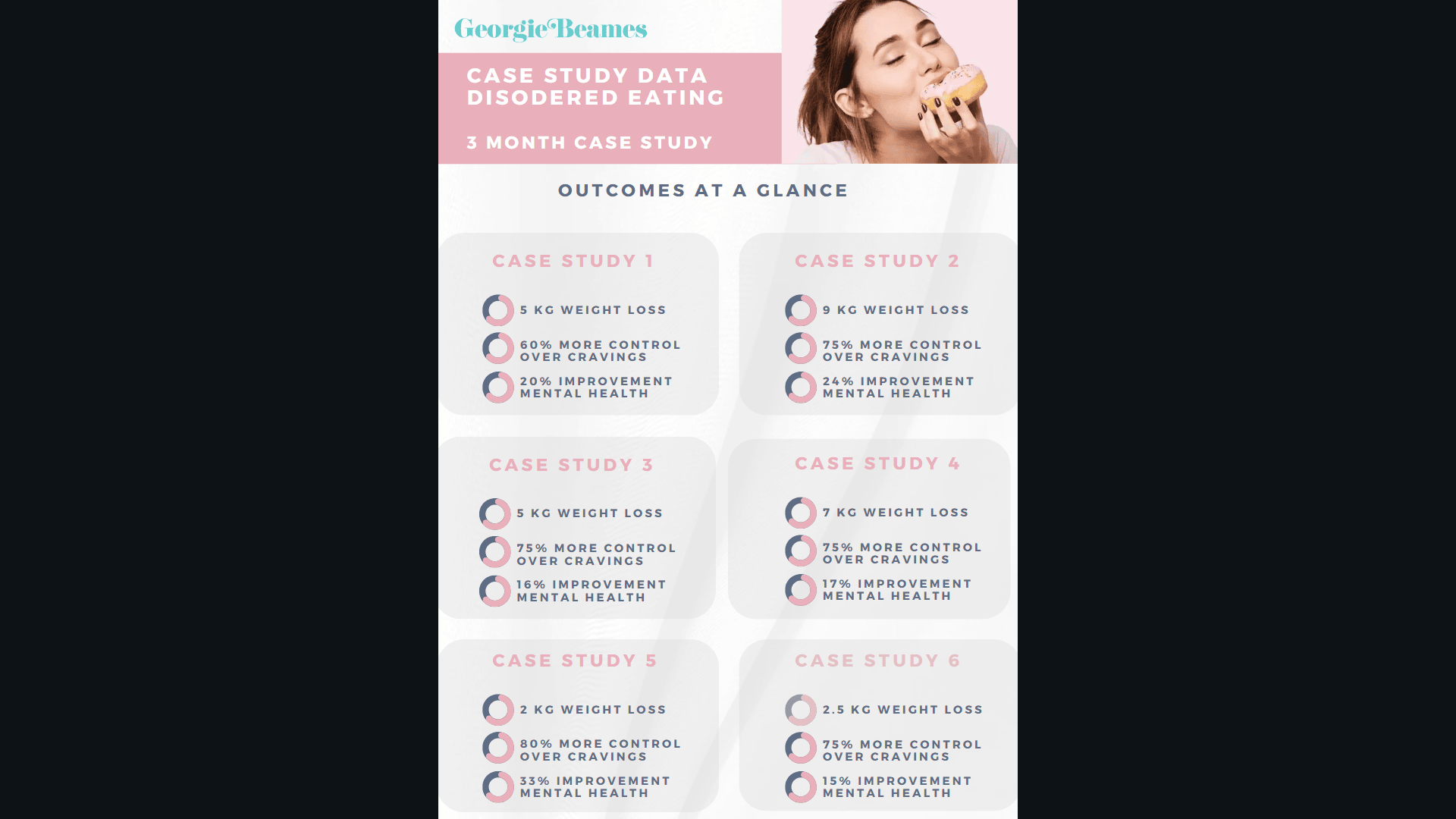
Improvements in food cravings control (60–90% more control), weight reduction (2–12 kg) & mental health improvements (15%–61%) in 12 weeks
Apply To Claim a 1 on 1 Root Cause Session with Georgie

Clinical Case Study Information

This material presents clinical data collected from participants who completed an intensive program. It is provided for educational and informational purposes only and is not a testimonial or endorsement.

Data and Anonymity: The qualitative video data was collected pre- and post-program. All personal identifying information has been removed to ensure client anonymity. Explicit consent was obtained from all participants for the use of their de-identified data in this case study format.

Outcome Variability: These case studies reflect the specific experiences of individuals who completed the program in full. They do not represent a guarantee of results. Individual outcomes in health services are inherently variable and depend on a wide range of personal factors. Results are not typical for all participants.

Case Study 1: Lost 10.5 kg (23 pounds)

  • Clinical Outcome: Observed 10.5 kg weight reduction. Participant reported a corresponding reduction in clothing size.
  • Participant identified a need to address psychological factors, including intergenerational patterns, influencing eating behaviours.

Case Study 2: Lost 12 kg

  • Low self worth, and eating due to past triggers (especially a difficult relationship with her mother).
  • Lost 12 kg in the program naturally and her mental health significantly improved by 61%.
  • Clinical Outcome: Participant reported a decreased desire for, and consumption of, highly palatable foods like chocolate and biscuits.

Case Study 3: Lost 3 kg

  • Food noise was her biggest concern and fear of failure (weight regain).
  • Dietitian recommended she try Ozempic to reduce her food noise.
  • Clinical Outcome: Participant reported a significant reduction in intrusive thoughts about food ("food noise") without needing weight loss medications.

Case Study 4: Lost 9 kg

  • Lost 9 kg during the program, and a total loss of 14 kg 3 months after the program ended.
  • Presenting Issue: Participant reported behaviours consistent with a compulsive consumption of chocolate.
  • Clinical Outcome: Post-program assessment indicated a cessation of these compulsive behaviours.

Case Study 5: Lost 5 kg

  • Night time eating was problematic before the program. Regained 10 kg after surgery. She lost half of the regain in the program.
  • Anxiety was contributing to night time eating.
  • The need to use food to relax or reward is now not needed as much after the program.
“Most people know what to eat, but it's exploring WHY you are eating that will be the key to your longer term success”

Case Study 6: Lost 2 kg

  • Clinical Outcome: Participant reported increased confidence in food-related situations and a cessation of cravings.
  • Did not realise how her childhood was affecting her eating today at 65 years.
  • Was snacking each night and stalled for months with her weight, and is now losing weight after the program (2 kg).

Case Study 7: Lost 7 kg — 15 kg loss since starting the program

  • Had a Gastric Band. Kept the weight off for 5 years.
  • Clinical Outcome: A 7 kg weight reduction was observed during the program. Participant reported a significant decrease in the frequency of cravings.
  • Trauma history, including child sexual abuse, that was affecting her eating and weight was healed during the program.

Case Study 8: Lost 3 kg

  • No longer snacks at night, which was her sabotaging pattern leading to weight regain.
  • Clinical Outcome: Participant reported improvements in self-perception and confidence regarding their eating behaviours.

Case Study 9: Lost 3 pounds

  • Has not had chocolate at night since starting the program.
  • Clinical Outcome: Participant reported a reduction in social comparison behaviours related to their surgical outcomes.

Case Study 10: Lost 8.5 kg

  • Clinical Outcome: Participant reported a cessation of temptation-related eating and a return to viewing food as fuel, a mindset previously achieved post-surgery.

Case Study 11: Lost 3.5 kg

  • Clinical Intervention: Addressed trauma using EMDR. Clinical Outcome: Participant demonstrated proficiency in using program tools, contributing to a 3.5 kg weight loss and prevention of further weight regain.

Read the Full Case Study Data

Full case study data - click to read

Before & After the 3 Month Intensive with Georgie

Lost 10.5 kg
  • 67% more control over cravings
  • 15% improvement on mental health
Lost 9 kg
  • 75% more control over cravings
  • 24% improvement on mental health
Lost 12 kg
  • 70% more control over cravings
  • 61% improvement on mental health
Lost 7 kg
  • 75% more control over cravings
  • 17% improvement on mental health
Lost 2 kg
  • 63% more control over cravings
  • 15% improvement on mental health
Lost 5 kg
  • 60% more control over cravings
  • 13% improvement on mental health
Lost 3 kg
  • 90% more control over cravings
  • 20% improvement on mental health
Lost 3 kg
  • 60% more control over cravings
  • 13% improvement on mental health

“Most people know what to eat, but it's exploring WHY you are eating that will be the key to your longer term success”

Apply To Claim a 1 on 1 Session with Georgie

DISCLAIMER

The information we provide on this page is offered as general educational content only. The information should not be considered as advice, it should not be used to treat, assess or diagnose a psychological condition, nor should it be used as an alternative to obtaining professional advice from a qualified allied health practitioner, psychiatrist or medical practitioner.

Where information refers to diagnostic categories, tests, or assessments these are provided also as information and for general education only. The results of any online test or assessment or guideline which you consult should not be relied on for self assessment and you should seek the opinion of a professional rather than relying on self-diagnosis.

Assessment of a mental health condition should not be made without proper qualification and you should always seek proper advice from a professional in obtaining a diagnosis or assessment.

Please always consult a professional health care provider about any health concerns you might have for yourself or on behalf of another person.

Georgie Beames does not accept any liability for any loss or damage associated with the use of this site.

Georgie Beames
Sign up to the

3 DAY CHALLENGE
Break up with your #1 most problematic eating habit

For just AUD$29 (that's only USD$20!) you can join the mini-challenge and start changing the way you react around food for good.

Get Started